I moved to Park Slope in August 2004. When I told my grandma – a lifelong Brooklynite – where we bought a condo, she replied, “well that’s not a great area.” Of course, she was talking about 20 or 30 years ago. It turns out, the Slope today is a great area. The combination of beautiful 19th century architecture, a clear grid system of streets, and proximity to
Friday, March 04, 2005
Geographic Profile: Park Slope, Brooklyn


7th avenue, looking north from about 8th street
Physical Design
Park Slope, as its name would suggest, is built on a gently sloping hill, with the park at the top. The neighborhood is defined by a grid system of streets, including two main commercial avenues – 5th and 7th – running north-south, and about 20 residential side streets running east-west, with the named and lower numbered streets at the northern end.
Both the streets and the avenues of the Slope have perfect proportions to accommodate a comfortable walking lifestyle. The avenues – lined with mostly four- and five-story buildings that are built fully out to the sidewalk – features only one lane of traffic in each direction, buffered from the curb by parked cars. The streets are mostly one-way, except for

the litchfield villa, built in the 1850's in what is now the western edge of prospect park. mr. litchfield owned much of what is now park slope.
History

a typical park slope street
Culture
Park Slope has a reputation as a politically progressive activist community. Much effort has been expended in the preservation of the historic integrity of the neighborhood, and Park Slope is the “Recycling Capital” of
Social concerns also occupy a high place on the neighborhood’s agenda. The area is home to numerous civic, merchant and social organizations that offer many forums for social discourse. The Park Slope Food Co-op is the largest member-owned and operated food co-op in the country, with over 10,000 members, many of whom participate on the Co-op’s political committees, addressing issues like genetically modified foods and the use of pesticides. The area also prides itself on its diversity and contains a spectrum of socioeconomic, ethnic, and cultural backgrounds. For example, it has the highest lesbian population in the City and has played host to
Of course, when walking the streets of Park Slope, you can’t help but notice all the babies, and all the yuppies. It seems like as soon as

the montauk club on 8th avenue
"Gentrification?"
As you can tell, there are many things I love about my neighborhood, but I tend to have mixed feelings about gentrification. On one level, it is clear that the neighborhood's hot real estate market is driving out families who will have to find another place to live. But that has already happened in Manhattan; which is why more people are moving into the Slope to begin with. I always feel awkward walking home from work in my business suit past the stoop-sitters who camp out all day on my block. But my family also has history in Park Slope. At the turn of the century, my Russian immigrant great grandfather owned a grocery store on 5th avenue, and he lived with his family on 6th avenue at 11th street until roughly the mid-1920's. So it seems different families have been replacing eachother for generations. Gentrification is often discussed in terms of it being a problem, but it is a complex topic, especially in relentlessly free-market American cities like New York, where everybody wants a piece of the same pie.
Monday, January 31, 2005
book review: dolores hayden, "building suburbia" & "field guide to sprawl"

In her two most recent publications, Dolores Hayden looks long and hard at suburban development patterns, and comes up with not only a way of contextualizing the decentralized built environment many of us find ourselves in, but also proposes some ideas as to how to improve it.
In "Building Suburbia," Hayden analyzes the patterns of government-subsidized private development outside of America's major city centers. She proceeds in chronological order, beginning in 1820, and continues thorough the present and near future, assessing prevalent development trends, and assigning catchy - if derisive - nicknames to nine types of suburban development characteristic of specific historical eras: "borderlands" (beginning circa 1820’s) "picturesque enclaves" (1850’s) "streetcar buildouts" (1870’s) "mail order and self built suburbs" (1900’s) "sitcom suburbs" (1940’s) "edge nodes" (1960’s) and "rural fringes" (1980’s-present).
Hayden shows through careful research how each type of pattern emerged, and by the book’s end, it becomes clear that the majority of suburban development was the product of years of builders' and regulators' intensive efforts at maximizing private profit at public expense. It may seem obvious when so stated that home building, like any other american industry, seeks a maximum return on profit and a comfortable regulatory environment in which to operate. But parts of this book are fascinating in the details of just how that regulatory environment was created, and the how decades of profit maximization in the suburban home and commercial building industries has shaped the daily experience of most americans. With a clear post-modern perspective, Hayden notes the racial, class, gender and environmental problems caused or exaccerbated by suburban development. And ever so rarely, she points out admirable attempts at good suburban design. The book begins with an examination of the group dynamic present in the early nineteenth-century suburban push. Hayden examines the tendencies toward upper-class communal country living, and includes many diagrams and pictures. She continues with the advent of streetcar suburbs, and the bizarre phenomenon of mail-order suburbs. The truly fascinating sections begin in the chapter on "sitcom suburbs,” when it becomes clear that the suburbs are no longer places to escape urban capitalism. Hayden begins one paragraph: "developers liked to say that the aquisition of a single family house and the process of furnishing and expanding it made blue collar residents ‘middle-class.’" It was also said that people who owned a suburban home and car(s) had to keep so busy to pay for their posessions that they could be counted on not to turn “communist.” In this respect, Hayden points out how suburban development became the heart of american capitalism and lent credence to the ideal of an open-class society.
By the 1950's, "vast american suburbs of the post-WWII era were shaped by legislative processes reflecting the power of the real estate, banking, and construction sectors, and the relative weakness of the planning and design professions." Among other key 20th century legislative changes, Hayden notes the rewriting of the federal tax code to permit write-offs for home mortgage payments and accellerated depreciation of the taxable value of new commercial construction in "greenfield" (i.e., open) areas. These innovations encouraged larger, more expensive homes, and cheaply made, poorly maintained shopping malls. In addition, the automobile, gas and cement lobbies combined to undermine earlier attempts at more dense, transport-efficient "streetcar suburbs," like Brooklyn Heights, New York. Eventually, most suburban residents became dependent on automobiles for basic needs, and automobiles, in turn, blew up the scale of suburban development, such that every home needed a garage or two, and every civic location needed expansive asphalt fields of parking.
Thus, by the end of the 20th century, upwardly mobile people came to live in huge homes located in far-flung and virtually random agglomerations of other huge homes, big-box retail stores, fast-food restaurants, freeways and office parks. Hayden examines the problems created by this set-up: long distances and high costs of car and home ownership combining to oppress low-wage service workers and immigrant nannies; asphalt runoff, auto exhaust and overextended infrastructure polluting the air and water; and a pervasive sense of placelessness and isolation. However, she almost completely ignores the segment of the population that is perfectly happy living in the suburbs. In that respect, her thesis is not comprehensive. She either assumes what she set out to prove – that the greater good served by reforming current development trends is paramount – or she assumes that the people who enjoy the ‘burbs – if they exist – are such a small contingent that they are not worth discussing.After describing the ills of sprawl, Hayden goes in search of solutions. She intelligently discusses the plusses and minusses of green building, "new urbanism," Disney-esque theme park developments, and the ever-so-creepy "house_n," designed by M.I.T. students and funded by – among other corporations – Proctor & Gamble and International Paper. However, Hayden believes these types of design innovations will not solve the problem entirely. She advocates for regional solutions, including the rebuilding of older suburbs, keeping in mind which of the historic development patterns originally created a particular place.
Of course, to completely re-value older suburbs, the federal tax code would have to be revised. But in the mean time, Hayden points to instances of thoughtful suburban design in projects like H.U.D.'s Concord Village in Inianapolis, which took account of historical building patterns of older suburbs in the area, and built houses consistent in scale and design.Hayden summarizes suburbia as "the hinge, the connection between past and future, between old inequalities and new possibilities. In all kinds of existing suburbs, inequalities of gender, class and race have been embedded in material form. So have unwise environmental choices." She concludes, "to preserve, renovate, and infill the suburban neighborhoods of the past can make the suburban city more egalitarian and sustainable."
These are admirable goals, and Hayden makes a good case for how and why to work toward them. And, thankfully, she includes many interesting diagrams and pictures. The question remains: is this what actual suburban residents actually want? And do their views matter? A recent New York Times article suggests that dense, walkable suburban development only commands 10% of new housing market demand.
In the “Field Guide to Sprawl” Hayden goes a step further with her descriptions of suburban development patterns. She combines crisp aerial photography of specific features of suburban “sprawl” with brief explanations of the snappy names given to such features by smug journalists and distressed planners and architects. Even more so than in Building Suburbia, it is clear that Hayden harbors not only a fascination, but also a distaste with conventional suburban development. In addition to the better known terms like "strip mall," Hayden provides some other keenly descriptive terms, like "edge node," "alligator," "zoomburb,” "parsley around the pig" and "pig in the python."
As is clear from those examples, this is, at its core, a book of jargon. And, as is the nature of jargon, the terms themselves are meaningless without decent explanation. Hayden provides good explanations sometimes, and some terms like edge node are almost self-explanatory. But other times, one wonders whether it will in fact be possible to identify the more obscure suburban features in real life, especially from the window of a passing car. And even assuming one can identify one feature or another, will anybody in the car understand when you say “hey, look, an alligator”? Nevertheless, it's a quick read, and especially if one harbors Hayden’s same slightly repulsed curiosity with suburbia, one will find it a thoroughly enjoyable – if not entirely useful – reading experience.
For more on what actual suburbanites actually want, see Robert Johnson, "Why 'New Urbanism' Isn't for Everyone," N.Y. Times (Feb. 20, 2005).
Monday, December 27, 2004
hey, neat! the waterfront! let's build a warehouse! no, a sewage station!
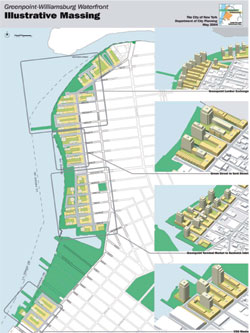
map: nyc dep't of city planning
when i lived in manhattan, i would go running along the "east river park." by that, i mean i would run along a narrow track adjacent to the east river, at one point darting in between the 14th street electricity generating station (which recently caught fire) and the fdr expressway, hoping a semi-rig would not skip over the 3-foot concrete barrier. when i wasn't fearing for my life, i would look out over the east river to the areas of brooklyn known as williamsburg and greenpoint. along that waterfront, abandoned warehouses and factories sat in ruins, as if they had sustained a severe shelling. i knew that the waterfront areas of old cities were sometimes not such the hot commodity for residential or recreational use, but come on, this is new york. how could that land just sit there, with so much potential, but so desolate? well, it seems that the area has been zoned for heavy manufacturing for quite a while, although heavy manufacturing is no longer what makes new york city tick. since the demise of the factories and warehouses, property owners have tried everything from building a waste transfer station to re-establishing the defunct times square porn industry.
but not so long ago, some bright person at the city planning department came up with a new plan: let's rezone! after much study, the new plan has coalesced, complete with a waterfront promenade and a series of parks, interspersed with 150- to 350- foot tall residential towers, public park space, but and 15% to 25% of the units reserved for low- and moderate-income residents.
but community opposition abounds. the community board for the area and the brooklyn borough president have rejected the city's plan, and locals have organized to demand more affordable housing (40%), more public space and no luxury high-rises. for more detail, see http://www.northbrooklynalliance.org/.
i tend to agree with the community groups on the high-rises. why must they be so tall? and why right on the water, rather than upland? the affordable housing i'm more ambivalent about. it all depends on the definition of "affordable," and there must be sensitivity to a spectrum of income levels, rather than just high and low. as for local residents' feelings that they have a say in the process, the city's land use review law certainly recognizes public input, and developers are better off asking for re-zoning if they have the community's support. but i think the really interesting question is: when and how do people begin to feel like they own their neighborhood, so much so that they are willing to fight for it? this is a theme i will return to in future posts.
but while all this winds its way through the land use review process, don't miss what could be your last chance to view the crumbling warehouses of greenpoint, those post-modern remains of a lost civilization, hulking darkly in semi-isolation along the shore of the east river. for optimum viewing, i suggest a nice run along the east river park.
[for more coverage, see diane cardwell, "city sees way to get mix of homes on brooklyn waterfront," n.y. times (dec. 27, 2004)].

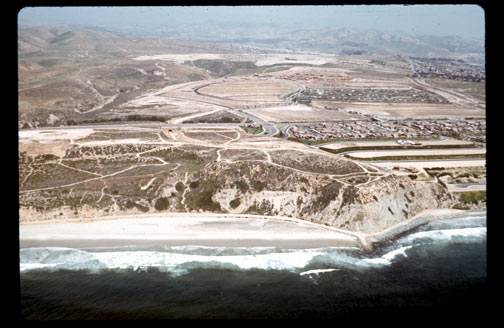
the o.c. now: salt creek point, orange county, california 2004

photo: kenneth & gabrielle adelman; california coastal records project
note: this photo was taken before the building of the st. regis, a mega-luxury resort, in that patch of dirt in the middle-left of the frame. the building on top of the point is the ritz-carlton.
book review: joan didion, "where i was from"

i grew up in orange county, california, in the 1980's and early 1990's. as you may not know from recent television melodramas, parts of the county "back then" maintained a vestige of rural charm. i remember watching cows grazing on the hillside across from a friend's house; i remember waking up one morning to greet a coyote skulking across my backyard. in the intervening decade -- which can be considered an eon in california-time -- southern orange county has taken on the mantle of a luxury beach resort, complete with sunburned transplants from the rest of the country playing golf in crushed-marble sand traps, and shopping in lines of pink stuccoed strip malls.

if you can detect my disdain for the newcomers, you are halfway into the california experience. in "where i was from," joan didion, a native californian of a few generations, peels back the california mystique to its bone. she, like most of us who grew up there, harbors a deep and abiding love for the unique, at times ancient, landscapes the state holds in abundance. she, too, seems to regret every new freeway and subdivision. but she finds that the heartwrenching development of the state's magical pastures is the essence of california, and it has been since the gold rush. from the railroad barons to agribusiness, to oil, aerospace, cookie-cutter suburbs and prisons, the phenomena of "selling the future to the highest bidder" has led to the confused sprawl that blankets many of the inhabited areas of the state, and leaves some of us wondering whether perhaps some of the traditions our forebears left back east weren't so bad after all. "discussion of how california has 'changed,' then, tends locally to define the more ideal california as that which existed at whatever past point the speaker first saw it."
for me, that was the cow grazing and the coyote skulking through the backyard. it will never be the same, but after reading this book, i, too, have accepted california for the constant change that it is, and i feel lucky to have been there back then.
Subscribe to:
Posts (Atom)